Sonomo is an Amsterdam-based fintech marketplace that makes music royalties accessible as an investable asset class. SPYNE supports that ambition with a scalable finance function connecting platform data, financial administration, reconciliation, reporting and CFO-level expertise.
Every stream generates a royalty. Until recently, investors had limited access to that income. Amsterdam-based Sonomo is changing that by turning music royalties into an accessible, transparent and tradable asset class.
What we essentially do is take an asset that historically has been difficult to invest in and make it investable.
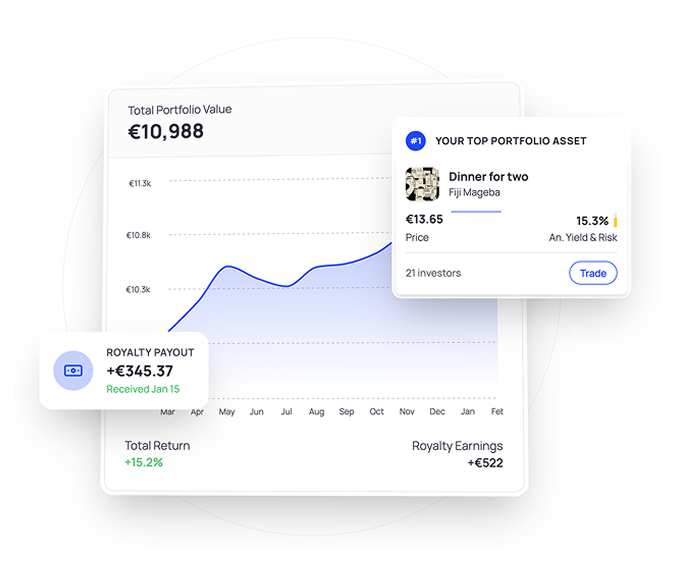
Sonomo has created a marketplace where investors can buy and sell shares linked to the royalty income of master recordings and receive monthly royalty earnings based on their ownership. For artists, labels and other rights-holders, the platform provides access to immediate liquidity and an additional way to monetise their catalogues.
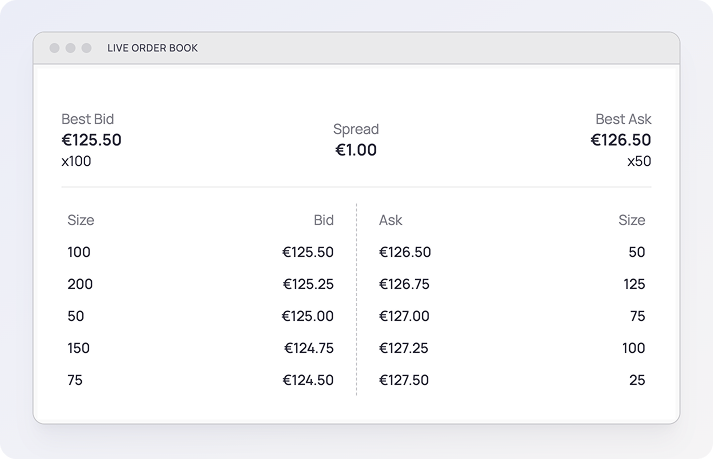
For investors, this provides access to an alternative asset class whose underlying income is driven primarily by listening behaviour. Behind that simple proposition sits a complex financial operation: hundreds of thousands of transactions, royalty payments and investor distributions.
Sonomo CEO Faris Zaher and CTO Sameh Alfar have worked together for around fifteen years. With their engineering and technology backgrounds, they approach finance as a data and systems challenge, not simply as an administrative function.
“What we essentially do is take an asset that historically has been difficult to invest in and make it investable,” Faris explains. “We make it possible to deploy capital and obtain exposure to music royalties, but we also provide the data investors need to make informed decisions. And then we take care of the copyright administration around it as well, which includes monthly royalty collection and distribution.”
Sonomo connects rights holders with investors ranging from retail investors to high-net-worth individuals, family offices and other professional investors.
“You can look at an individual song, but you can also create diversified exposure,” says Faris. “Our robo-advisor solution can follow a chosen strategy to build and rebalance a portfolio, similar to a personalised ETF.”
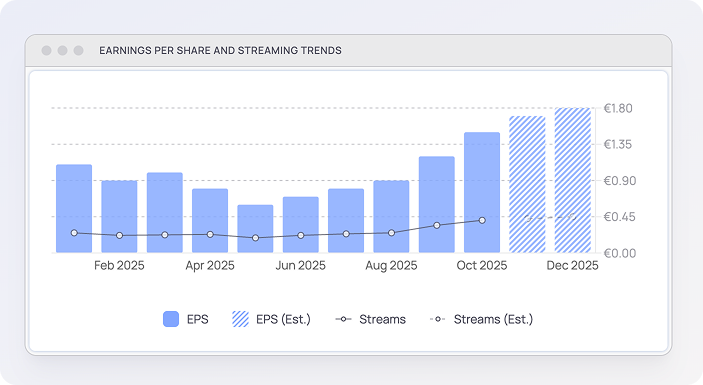
“Music behaves differently from many traditional assets,” he continues. “It generates income, royalties are paid out periodically, and you can create exposure across artists, countries, genres and currencies. We turn something that used to be opaque into a transparent investable asset.”
The easier Sonomo makes the experience for investors, the more sophisticated the operation behind it becomes. Rights holders, trading liquidity, streaming data and royalty distributions create a substantial flow of financial and operational data.
“We have investors in the company ourselves, including a few VCs and angel investors,” says Faris. “As you grow, you want to be able to answer questions quickly. You want real-time information about your financial position whenever somebody asks for information. The basis should simply be there.”
Sonomo needed a financial rhythm in which administration, reconciliation, reporting and management information are consistently connected.
“With the amount of data we process, financial administration is not a standalone activity,” Sameh explains. “Our systems generate data, finance consumes that data, and ultimately it has to come together in reporting. Getting the engineering and financial sides properly synchronised is not trivial.”
That is where SPYNE comes in. SPYNE builds and runs scalable finance functions for fast-growing and transaction-heavy businesses, integrating day-to-day financial operations, reporting and CFO-level expertise without requiring companies to build every capability in-house.
There was real curiosity, they actually wanted to understand how the company works, why transactions flow in a certain way and what sits behind the numbers.
SPYNE was introduced to Sonomo following a direct recommendation from one of its venture capital investors, giving the collaboration an important foundation of trust from the outset.
“Our business model is financially complex,” Faris says. “We are not a straightforward SaaS or trading company. If you don't understand the business model, it becomes very difficult to properly structure the finance function around it.”
SPYNE started by understanding Sonomo’s business model, transaction flows and underlying data architecture.
“There was real curiosity,” Faris says. “They actually wanted to understand how the company works, why transactions flow in a certain way and what sits behind the numbers.”
SPYNE’s flexible model matched Sonomo’s stage of development. Sonomo needed access to a range of senior financial experts without having to build a large in-house finance team.
“We can tap into different levels of expertise when we need them,” Faris says. “Some work is operational, some is more strategic and sometimes you need CFO-level thinking. You don’t necessarily need to hire all those functions full-time. What matters is that SPYNE is not just advising us from a distance.
They are a hands-on partner: they work with the numbers, coordinate the people involved, help solve issues as they arise and then step up to a more strategic level when the situation requires it. That combination is very valuable.”
Today, SPYNE coordinates and oversees the finance function supporting Sonomo.
Transaction processing and administration are performed by a third party under SPYNE’s supervision, while SPYNE oversees the financial structure, control framework, reporting process and management information.
Reconciliation is where it matters most.
“When you are dealing with very large numbers of transactions, everything has to match at the end of the month,” Sameh explains. “You need confidence that the data coming from the platform ultimately connects with the financial administration. This isn't traditional bookkeeping. If you don't get that connection right, it can become a fundamental business problem.”
Each month, Sonomo and SPYNE review the financial reporting, performance and forward-looking priorities. When questions arise around finance, tax, funding, legal structuring or financial projections, SPYNE can bring in the relevant expertise.
For Faris, one of the most valuable results is what he calls “financial hygiene”.
“Founders are not always naturally great at financial hygiene,” Faris says. “As an entrepreneur, your attention is constantly pulled towards the product, customers, hiring and growth. This should never come at the expense of finance and legal, even at the early stages of a Fintech business. You need someone who makes sure everything is structured, checked and consistently maintained.” For venture capital and private equity investors, that discipline is essential. They need reliable financial information, clear documentation and confidence that key finance and legal processes are under control. Having a hands-on partner who keeps that foundation in order helps management meet those expectations continuously, rather than having to repair gaps when a board, investor or potential new funder asks for information.
This becomes particularly important when investors ask questions or the company enters a financing process. “If you are raising money and everything is already there, properly structured and formatted, that is incredibly liberating,” Faris says. “You're not suddenly trying to clean things up. You know where you stand.”
Reliable information also changes the conversation with SPYNE: it shifts from reporting historic results to interpreting performance and deciding what comes next.
“When the underlying information is reliable, you can actually discuss what it means,” Faris says. “Then SPYNE can challenge us, ask questions and help us think about what we should do next.”
I would definitely recommend SPYNE to companies operating in fintech or other environments with large transaction volumes. If you’re processing hundreds of thousands of transactions and need to connect engineering, data and finance, that’s not simple.
Since expanding its offering to high-net-worth individuals, family offices and larger investors, its financial foundation becomes even more important. Higher transaction volumes and investment sizes require reliable processes, transparent data and consistent reporting.
For SPYNE founder Paul Smit, the objective is to ensure that financial capability scales alongside the platform.
“Our role is to ensure that Sonomo’s finance function develops at the same pace as the platform. As the business grows and transaction volumes increase, its financial processes, controls and reporting need to scale with it. Control and transparency should be built into the organisation, not added afterwards.”
Faris sees a clear fit with SPYNE.
“I would definitely recommend SPYNE to companies operating in fintech or other environments with large transaction volumes. If you’re processing hundreds of thousands of transactions and need to connect engineering, data and finance, that’s not simple.”
“It’s not bookkeeping. You need people who can consume large amounts of data, understand what is happening operationally and translate it into financial reporting and insights. SPYNE can operate at that intersection. That’s where I think they are genuinely different.”
For Sonomo, the collaboration is not simply about keeping the numbers in order. It is about building a scalable finance function that provides the control, reporting and insight required to grow a financial exchange for music royalties.